Projects
The Effect of Compulsory Education on Future Earnings in the U.S.
June 2025- Research project supervised by Dr. Thomas Richardson (Department of Statistics, University of Washington).
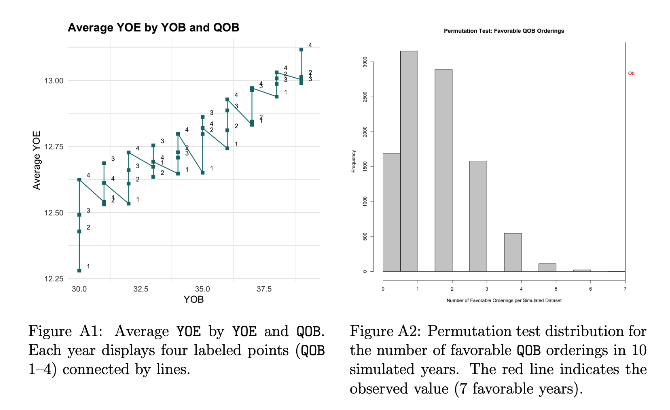
- Studied the causal effect of education on future earnings in the United States using compulsory schooling laws, with Quarter of Birth (QOB) as an instrumental variable.
- Implemented econometric and causal inference methods, including:
- Two-Stage Least Squares (2SLS) to estimate the return associated with an additional year of education.
- Fast Causal Inference (FCI) to assess instrumental-variable assumptions and investigate the possibility of hidden confounding.
- Nonparametric polytope methods to obtain bounds on causal effects under weaker assumptions.
- Findings highlighted the contrast between precise parametric estimates and substantially wider nonparametric bounds, emphasizing the limitations of weak instruments and strong modeling assumptions.
- Poster presented at the HUB, University of Washington.
-
Project Report
 |
Poster
|
Poster
Forest Change Detection: Random Forest Classifier Model based on Sentinel-2 and Landsat Imagery
June 2024- Collaborated in a team of five to develop a machine learning pipeline for detecting forest change from satellite imagery in an industry-focused setting. Team members: Arman Jahangiri, Brian Andres Zambrano Luna, Issac Asamoah, Patrik Coulibaly, and Yasaman Shahhosseini.
- Worked with industry partner Finite Carbon under the mentorship of Bahareh Yekkehkhany.
- Acquired and processed ESA Sentinel-2 and Landsat imagery using Google Earth Engine and the United States Geological Survey.
- Performed data preprocessing steps including cloud masking, feature engineering, and geospatial alignment across satellite sources.
- Built and optimized a Random Forest classifier using grid search for model selection and performance improvement.
- Presented findings and actionable recommendations to Finite Carbon and other industry stakeholders during the program’s graduation event.
-
Certificate

High-Dimensional Binary Classification with Rare and Weak Signals
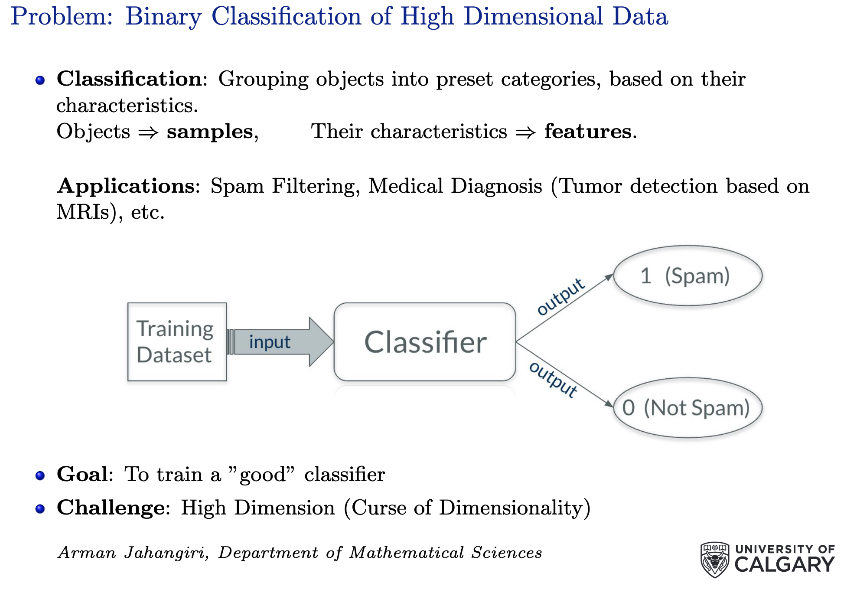
May 2024- Presented research on binary classification in high-dimensional settings with sparse and weak signals.
- Introduced classification fundamentals and motivating applications, including genomic data analysis and spam detection.
- Discussed key statistical classifiers, including logistic regression, k-nearest neighbors, Linear Discriminant Analysis (LDA), and Quadratic Discriminant Analysis (QDA).
- Developed a theoretical framework addressing challenges arising from the curse of dimensionality.
- Presented impossibility regions and new theoretical results characterizing the optimality and limitations of QDA under specific signal regimes.
- Included computational analyses and alternative classification strategies supported by theoretical insights and performance comparisons.
-
Slides (Contributed Talk)
 |
Slides (Three-Minute Thesis Competition - Second Place Award)
|
Slides (Three-Minute Thesis Competition - Second Place Award)
Shapiro–Wilk Test of Normality
November 2023- Collaborated on a group project analyzing the Shapiro–Wilk test and selected extensions for assessing normality in data.
- Team members: Asal Rahmani Lahoot, Arman Jahangiri, Shiyu Sun, and Jessica Grant.
- Conducted a literature review of related work on normality testing.
- Studied the theoretical construction of the Shapiro–Wilk test statistic and reproduced benchmark results from the literature.
- Implemented the methods in R and compared the Shapiro–Wilk procedure with other normality tests in practice.
-
Slides

Predictive Data Analysis on Clinical Data Using LASSO and Binomial Regression
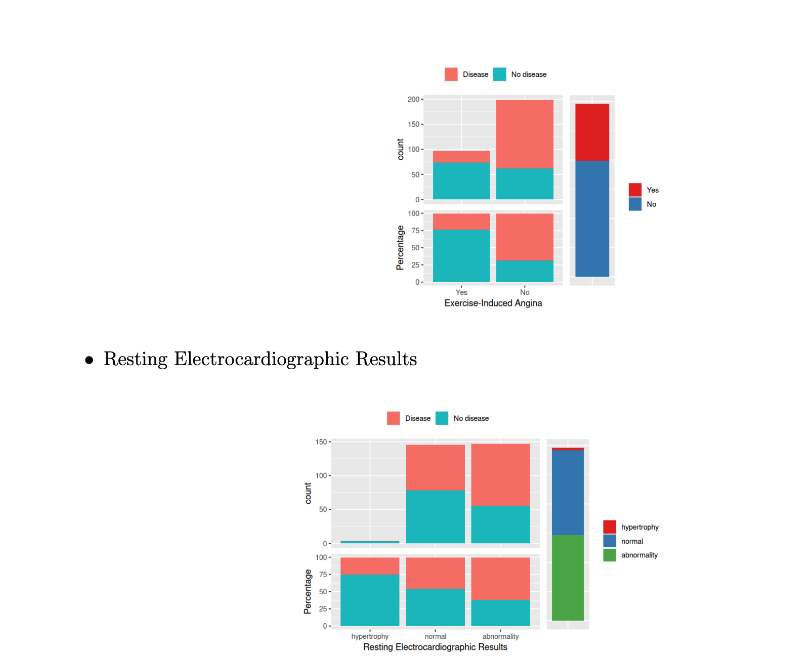
October 2023- Conducted a data analysis project on a heart disease dataset with a focus on binomial regression models combined with feature-selection methods.
- Team members: Arman Jahangiri, Mojtaba Kanani Sarcheshmeh, and David Yang.
- Applied LASSO, forward selection, and backward selection to identify relevant predictors and improve model interpretability.
- Estimated heart disease likelihood and predicted chest pain type using patient-level covariates.
- Analyzed the relative risk associated with clinical variables and explored associations among heart-health factors.
- Performed preprocessing, exploratory data analysis, and visualization to support interpretation and communication of results.
-
Project Report
 |
Slides
|
Slides
Profile Likelihood Inference for Semiparametric Varying-Coefficient Partially Linear Models
June 7, 2023 to June 16, 2023- Delivered a contributed talk on semiparametric varying-coefficient partially linear models (VC-PLMs) and their role in modeling complex data relationships.
- Presented theoretical ideas related to profile likelihood ratio tests, asymptotic properties, and bandwidth selection methods based on the work of Fan and Huang (2005).
- Emphasized the flexibility of VC-PLMs for robust semiparametric inference in applied statistical settings.
-
Slides